
Entresto® in Dogs — How It Works and What the Veterinary Studies Show
Entresto® in Dogs — How It Works and What the Veterinary Studies Show

Entresto® in Dogs — How It Works and What the Veterinary Studies Show
By Christina Bové, DVM, MS, DACVIM (Cardiology)
“What makes Entresto interesting isn't the possibility of replacing a therapy we already know works. It's the possibility of adding another therapy that targets heart failure in a fundamentally different way.”
Heart Failure Is More Than a Weak Heart
When we think about congestive heart failure, it is easy to focus on what we can see clinically: pulmonary edema, cardiac enlargement, tachypnea, exercise intolerance, or episodes of syncope.
But behind those findings is a complex neurohormonal response.
As cardiac disease progresses and effective circulation becomes compromised, the body activates several compensatory mechanisms designed to maintain blood pressure and organ perfusion. Initially, these responses can be beneficial. Chronically, however, they can become part of the problem.
One of the most important is the renin-angiotensin-aldosterone system (RAAS).
RAAS activation promotes:
Vasoconstriction
Sodium and water retention
Aldosterone secretion
Increased preload and afterload
Myocardial fibrosis and adverse remodeling
This is one reason RAAS modulation has been part of heart failure therapy for decades.
But RAAS is only half of the story.
The Heart Has Its Own Protective System
As myocardial wall stress increases, the cardiovascular system releases natriuretic peptides, including atrial natriuretic peptide (ANP) and B-type natriuretic peptide (BNP).
These hormones counter many of the effects of RAAS by promoting:
Natriuresis
Diuresis
Vasodilation
Reduced aldosterone secretion
Reduced sympathetic activation
Antifibrotic and anti-remodeling effects
In simplified terms:
RAAS says: retain sodium and water, constrict blood vessels, and maintain perfusion.
The natriuretic peptide system says: excrete sodium and water, dilate blood vessels, and decrease cardiac workload.
The problem is that natriuretic peptides are broken down in part by an enzyme called neprilysin.
And this is where Entresto becomes interesting.
Two Drugs. Two Complementary Pathways.
Entresto® combines sacubitril + valsartan, creating an angiotensin receptor-neprilysin inhibitor (ARNI).
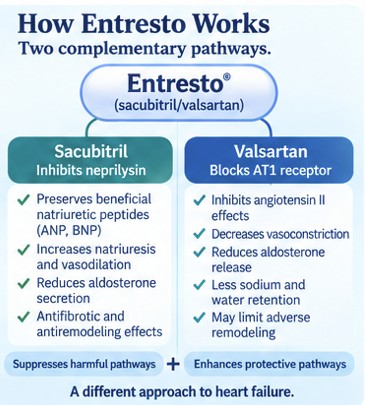
Sacubitril: Preserve the Protective Pathway
Sacubitril inhibits neprilysin.
By decreasing the breakdown of endogenous natriuretic peptides, neprilysin inhibition can enhance their physiologic effects, including natriuresis, vasodilation, and modulation of maladaptive remodeling.
Rather than simply blocking another harmful pathway, sacubitril helps preserve a compensatory system the body is already using.
Valsartan: Suppress the Maladaptive Pathway
Valsartan is an angiotensin II receptor blocker (ARB).
It blocks the AT1 receptor and therefore reduces many of the downstream effects of angiotensin II, including vasoconstriction and aldosterone-mediated sodium and water retention.
Together, the two components allow us to approach neurohormonal activation from both directions:
Suppress maladaptive RAAS signaling while enhancing the natriuretic peptide system.
That is fundamentally different from simply adding another ACE inhibitor.
It is also fundamentally different from the mechanism of pimobendan.
And that distinction is important.
This Is Not Entresto Versus Pimobendan
I want to make this very clear because it is central to how I think about this medication.
I am not interested in Entresto as a replacement for pimobendan.
Pimobendan remains a cornerstone of MMVD therapy and is supported by robust prospective canine outcome data.
Entresto targets different pathways.
Pimobendan provides inotropic and vasodilatory effects through calcium sensitization and phosphodiesterase III inhibition. Sacubitril/valsartan primarily targets neurohormonal regulation through neprilysin inhibition and angiotensin-receptor blockade.
That makes these therapies potentially complementary rather than competitive.
The question I find much more interesting is:
Could adding sacubitril/valsartan to contemporary MMVD therapy—including pimobendan—provide additional clinical benefit?
Before looking at the canine studies, however, it is worth understanding why this medication generated so much excitement in human cardiology.
The Human Trial That Changed Heart Failure Therapy
The landmark PARADIGM-HF trial enrolled 8,442 human patients with heart failure and reduced ejection fraction (HFrEF).
Patients were randomized to sacubitril/valsartan or enalapril. The primary endpoint was a composite of cardiovascular death or hospitalization for heart failure.
The results were impressive.
The primary endpoint occurred in 21.8% of patients receiving sacubitril/valsartan versus 26.5% receiving enalapril. Cardiovascular death occurred in 13.3% versus 16.5%, and hospitalization for heart failure was also significantly reduced.
But another part of the study is particularly interesting:
PARADIGM-HF was stopped early for benefit.
What Does “Stopped Early” Mean?
The investigators didn't simply see encouraging preliminary results and decide to end the study.
The trial incorporated prespecified stopping rules. An independent monitoring committee reviewed accumulating data, and the threshold required to terminate the trial early for benefit was deliberately stringent.
After a median follow-up of approximately 27 months, that predefined threshold was crossed. Enrollment had already been completed, with all 8,442 patients randomized.
In other words, the evidence favoring sacubitril/valsartan had become sufficiently compelling to meet criteria established before the results were known.
And veterinary cardiologists have seen something very similar before.
We've Seen This Before: EPIC
The EPIC trial was also stopped early for benefit.
EPIC evaluated pimobendan versus placebo in dogs with preclinical MMVD and cardiomegaly.
The study incorporated a preplanned interim analysis with predefined stopping criteria for convincing evidence of efficacy and safety. That analysis was performed after approximately 80% of the initially anticipated study period had been completed.
The predefined efficacy criterion was met, leading to unblinding and termination of the study. All 360 dogs had already been enrolled.
There is an interesting parallel here:
EPIC was stopped early because the evidence supporting pimobendan became sufficiently convincing. PARADIGM-HF was stopped early because the evidence supporting sacubitril/valsartan became sufficiently convincing.
But this is also where the comparison has to stop.
EPIC demonstrated clinically meaningful benefit in dogs with MMVD.
PARADIGM-HF demonstrated clinically meaningful benefit in humans with HFrEF.
Dogs with MMVD are not humans with HFrEF. Their underlying disease, ventricular function, natural history, concurrent medications, and heart-failure physiology differ.
PARADIGM-HF therefore gives us a compelling reason to study Entresto in dogs.
It does not prove that dogs will receive the same benefit.
What we still need is the canine Entresto trial that connects those two stories.
So, what do the veterinary studies actually show?
The Veterinary Evidence: Three Studies, Three Different Questions
This is the part of the Entresto story I think veterinarians need to understand in detail.
We now have published canine studies spanning Stage B2 MMVD, symptomatic Stage C disease, and real-world dogs with Stage C and D CHF.
But the studies weren't designed to answer the same question.
One examined pharmacodynamic and neurohormonal effects.
One examined short-term echocardiographic changes.
And the newest provides real-world safety and survival observations in dogs receiving chronic therapy.
Together, they provide an interesting progression of evidence.
Study 1: Newhard et al. 2018 — Does Entresto Actually Affect Neurohormonal Physiology in Dogs?
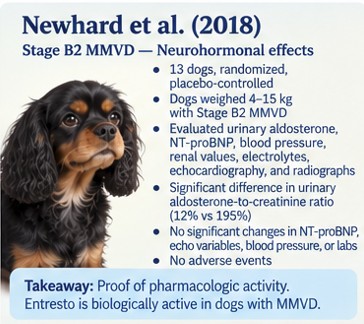
The first important canine MMVD study was published by Newhard and colleagues in 2018 in the Journal of the American Veterinary Medical Association (JAVMA).
This was a prospective, randomized, double-blind, placebo-controlled pilot study.
Only 13 client-owned dogs were enrolled:
7 received sacubitril/valsartan
6 received placebo
The dogs weighed 4–15 kg and had Stage B2 MMVD. Inclusion criteria included LA/Ao ≥1.6, indexed LVIDd ≥1.7, and VHS >10.5 in addition to evidence of MMVD and mitral regurgitation.
This was not a survival trial.
It was really asking a much earlier question:
Does sacubitril/valsartan actually produce the expected pharmacodynamic effects in dogs with naturally occurring MMVD?
What Did They Measure?
The investigators evaluated several variables, including:
Urinary aldosterone-to-creatinine ratio
Plasma NT-proBNP
Systolic arterial pressure
Renal function
Serum electrolytes
Echocardiographic measurements
Thoracic radiographic measurements
The dogs were followed for 30 days.
What Did They Find?
The most interesting result involved urinary aldosterone-to-creatinine ratio (UAldo:C).
From baseline to day 30, the median percentage increase in UAldo:C was 12% in the sacubitril/valsartan group versus 195% in the placebo group. That difference was statistically significant.
That is important because it provides evidence that sacubitril/valsartan is actually modifying the neurohormonal physiology we are trying to target.
However, the rest of the results are equally important when interpreting the study.
There was no significant between-group difference in the change in NT-proBNP, and the investigators found no significant differences between groups in echocardiographic measurements, thoracic radiographic measurements, systemic arterial pressure, or serum biochemical testing. No adverse events were reported.
What Does Newhard Actually Tell Us?
I think of this as a proof-of-concept study.
It tells us that sacubitril/valsartan is biologically active in dogs with naturally occurring MMVD and appears capable of altering RAAS physiology.
It does not tell us that Entresto:
Delays CHF
Improves quality of life
Reduces cardiac-related death
Extends survival
The more interesting research question is whether neurohormonal modulation with sacubitril/valsartan could eventually provide additional benefit alongside established therapy.
Newhard gave us an important first answer:
The drug does something biologically meaningful in dogs.
The next study asked whether we could actually see an effect on the heart.
Study 2: Saengklub et al. 2021 — Can We See Evidence of Reverse Remodeling?
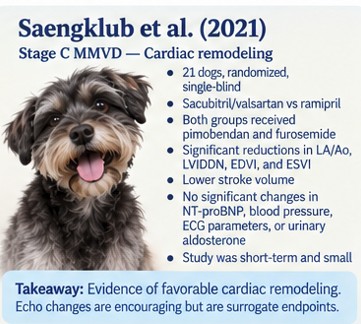
Saengklub and colleagues moved the question into dogs with symptomatic Stage C MMVD in their study published in Frontiers in Veterinary Science
This was a prospective, randomized study involving 21 dogs.
11 received sacubitril/valsartan
10 received ramipril
The sacubitril/valsartan dogs received an average dose of approximately 20.8 mg/kg, while the ramipril group received approximately 0.17 mg/kg ramipril.
What Did They Find?
After four weeks, dogs receiving sacubitril/valsartan had significantly greater reductions in several echocardiographic measures of cardiac size, including LA/Ao, LVIDDN, EDVI, and ESVI, compared with dogs receiving ramipril. The authors interpreted these changes as evidence consistent with short-term reverse cardiac remodeling.
Other measured variables—including NT-proBNP, blood pressure, ECG parameters, and urinary aldosterone-to-creatinine ratio—did not differ significantly between groups. Given the small study population and short follow-up period, however, I would view the echocardiographic remodeling signal as the more clinically interesting finding rather than expecting every biomarker or physiologic variable to change simultaneously.
What Does Saengklub Actually Tell Us?
This study provides evidence that adding sacubitril/valsartan to a treatment protocol that already included pimobendan and furosemide may produce measurable short-term reductions in cardiac dimensions compared with ramipril.
That is encouraging, particularly in a disease characterized by progressive volume overload and cardiac enlargement.
But the study was small and lasted only four weeks. Improvement in echocardiographic remodeling is a surrogate endpoint. We still do not know from this study whether those changes translate into fewer CHF recurrences, improved quality of life, reduced diuretic requirements, or longer survival.
So I view Saengklub as another step forward:
Newhard demonstrated neurohormonal activity.
Saengklub demonstrated measurable cardiac changes consistent with favorable remodeling.
But we still didn't know what would happen when this medication was used chronically in the older, complicated CHF patients we actually see in practice.
That is what makes the newest study particularly interesting.
Study 3: Carlson & Stern 2026 — What Happens in Real-World DMVD CHF Patients?
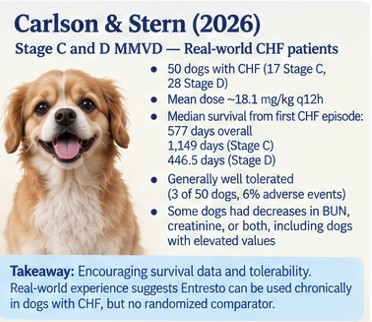
In 2026, Carlson and Stern published the largest clinical report to date in Am J Vet Res. evaluating chronic sacubitril/valsartan use in dogs with CHF secondary to MMVD.
This was a retrospective cohort study of 50 dogs treated between February 2023 and December 2025.
The mean sacubitril/valsartan dose was:
18.1 ± 5.4 mg/kg PO q12h.
This population is clinically important.
These weren't simply stable preclinical dogs being treated for 30 days.
These were dogs with established congestive heart failure, including dogs with advanced disease, being treated chronically in a real-world clinical setting.
The study was designed specifically to evaluate safety and survival data associated with chronic sacubitril/valsartan therapy.
What Did the Survival Data Show?
Five dogs were excluded from the survival analysis according to the study criteria, leaving 45 dogs:
17 were Stage C — dogs with current or previous congestive heart failure that remained responsive to standard heart-failure therapy.
28 were Stage D — dogs with advanced or refractory congestive heart failure requiring treatment beyond standard Stage C therapy.
The reported median survival time following the first episode of CHF was:
577 days overall
1,149 days for Stage C dogs
446.5 days for Stage D dogs
Putting Those Survival Times Into Context
Those numbers become more interesting when we look at survival reported in previous studies of dogs with CHF secondary to MMVD.
In the QUEST trial, dogs with CHF receiving pimobendan had a median time of 267 days to the composite endpoint of cardiac death, euthanasia for cardiac reasons, or treatment failure.
In the later VALVE trial, which evaluated dogs with CHF receiving pimobendan and furosemide with or without ramipril, the median time to the primary composite endpoint was 214 days overall. There was no significant difference between dual therapy and triple therapy.
Survival is generally shorter once dogs progress to advanced or refractory heart failure. In a 2018 retrospective study by Beaumier et al., 54 dogs with advanced heart failure secondary to degenerative mitral valve disease had a median survival of 281 days after the diagnosis of advanced heart failure. In that study, advanced heart failure was defined as recurrence of CHF despite treatment with pimobendan, an ACE inhibitor, and furosemide at >4 mg/kg/day.
More recently, Oricco et al. (2026) evaluated 61 dogs specifically classified as ACVIM Stage D MMVD. The median time from Stage C to Stage D was 245 days, and median cardiac survival after reaching Stage D was only 155 days.
Against that background, the survival reported by Carlson and Stern—577 days overall, 1,149 days for Stage C dogs, and 446.5 days for Stage D dogs—is certainly encouraging. The Stage D finding is particularly intriguing given the advanced nature of disease in these patients.
However, there is a major caveat:
These survival numbers cannot be compared head-to-head across studies.
QUEST, VALVE, Beaumier, Oricco, and Carlson differed in patient populations, definitions of disease severity, background medications, treatment era, endpoints, and study design. Even the outcome being reported was not always the same: QUEST and VALVE evaluated time to composite clinical endpoints, whereas other studies reported survival after reaching a particular disease stage.
Most importantly, the Carlson and Stern study was retrospective and did not include a randomized contemporary control group.
We therefore cannot conclude:
Entresto caused these dogs to live longer
What we can say is that the survival signal is sufficiently encouraging—particularly in dogs with advanced disease—to justify serious prospective investigation.
The question now becomes:
Would adding sacubitril/valsartan to contemporary MMVD therapy improve survival and other meaningful clinical outcomes compared with contemporary therapy alone?
That is the trial I want to see.
What About Adverse Effects?
Sacubitril/valsartan was generally well tolerated in the Carlson and Stern study. Only 3 of 50 dogs (6%) had adverse events attributed to the medication. Two dogs developed gastrointestinal signs, and one dog developed progressive clinically meaningful azotemia requiring discontinuation of sacubitril/valsartan and renal supportive care.
That is encouraging, particularly considering that this was a population of dogs with established CHF, including dogs with advanced disease receiving multiple cardiac medications.
It does not, however, mean the medication is risk-free. Sacubitril/valsartan can affect blood pressure, renal function, and potassium balance, making blood pressure, renal values, electrolytes, hydration status, and concurrent medications important considerations when deciding how to initiate and titrate therapy.
The practical details of how I approach those risks—including what I monitor and when—will be covered in Part 3.
And Then There Is the Kidney Question
One of the most clinically relevant questions surrounding sacubitril/valsartan is what happens to renal function.
This matters because the dogs in whom we are most likely to consider adding another heart-failure medication are often older, receiving chronic loop diuretics, and may already have some degree of azotemia.
The Carlson study provides some reassuring real-world experience, but I think the renal findings need to be interpreted carefully.
Some dogs experienced decreases in BUN, creatinine, or both during treatment, including dogs that entered the study with elevated renal values. At the same time, renal values increased over time in other dogs, and one dog developed progressive azotemia significant enough to discontinue sacubitril/valsartan.
So I would not interpret this study as evidence that Entresto improves renal function or is renoprotective.
There are too many potential explanations for changes in renal values in dogs with CHF: hydration status, diuretic dose, blood pressure, cardiac output, renal perfusion, concurrent medications, and progression of underlying kidney or cardiac disease.
Instead, I think the clinically useful message is more measured:
Mild pre-existing azotemia may not automatically exclude a dog from consideration for sacubitril/valsartan—but renal function needs to be evaluated in the context of the entire patient and monitored closely.
That is particularly relevant in advanced MMVD, where balancing congestion, diuretic therapy, renal function, and blood pressure is already part of everyday management.
And it leads directly into one of the most important practical questions we will address in Part 3.
What Do the Three Veterinary Entresto Studies Tell Us Together?
I think the easiest way to understand the canine evidence is to look at what each study actually asked:
Study | Dogs | What was the study really asking? | What did we learn? |
|---|---|---|---|
Newhard 2018 | 13 Stage B2 | Does sacubitril/valsartan have measurable pharmacodynamic activity in canine MMVD? | Yes. Evidence of altered aldosterone/RAAS physiology |
Saengklub 2021 | 21 Stage C | Are there short-term cardiac changes compared with ramipril? | Yes. Several echocardiographic indices improved in a direction consistent with reverse remodeling |
Carlson & Stern 2026 | 50 Stage C/D CHF | What happens with chronic use in real-world CHF patients? | Encouraging. Generally favorable tolerability and notable survival observations, but without a randomized comparator |
Taken together, the progression is compelling:
Biologic activity → cardiac remodeling → real-world chronic use
But there is still one major piece missing:
Prospective evidence of incremental clinical benefit.
What We Still Don’t Know
This is where it is especially important to separate promising evidence from proven clinical benefit.
We still do not have a large, prospective, randomized canine clinical trial showing that adding sacubitril/valsartan to contemporary MMVD therapy improves the outcomes that matter most.
And the unanswered question may actually be different depending on the stage of disease.
Could Entresto Have a Role in Stage B2?
This is an especially interesting question because the earliest canine Entresto study was actually performed in dogs with Stage B2 MMVD.
In the Newhard study, all 13 dogs were receiving pimobendan, and they were randomized to receive either sacubitril/valsartan or placebo in addition to pimobendan. Sacubitril/valsartan significantly altered aldosterone physiology over the 30-day study period, providing evidence that the drug has measurable neurohormonal effects even before CHF develops.
But the study was small and short, and it was never designed to determine whether those neurohormonal effects translate into a clinically meaningful benefit.
So we do not know whether adding Entresto to pimobendan in Stage B2:
Slows progressive cardiac enlargement
Dlays the first onset of CHF
Prolongs the preclinical period
Ultimately improves survival
That distinction is important because pimobendan already has strong prospective evidence for delaying the onset of CHF in Stage B2 MMVD. Entresto does not. The question is therefore not whether sacubitril/valsartan should replace pimobendan in B2—it should not based on the evidence we currently have.
The much more interesting question is:
Could adding sacubitril/valsartan to pimobendan delay the onset of CHF even further?
Newhard gives us a biologic reason to ask that question. It does not yet give us the answer.
What About Stage C and D?
Once CHF has developed, the outcome questions change.
Here, I would want to know whether adding sacubitril/valsartan to contemporary CHF therapy:
Reduces recurrent CHF events
Reduces hospitalization or the need for escalating diuretic therapy,
Improves quality of life
Slows progression from Stage C to refractory Stage D disease,
Reduces cardiac-related mortality
Prolongs survival
The Saengklub and Carlson studies give us encouraging signals in this population, but neither provides definitive prospective evidence that Entresto improves these clinical outcomes.
The Studies I Want to See
I actually think there are two important prospective Entresto trials we need in dogs.
The first would be a Stage B2 trial.
Dogs with well-defined Stage B2 MMVD would continue pimobendan and be randomized to receive sacubitril/valsartan or placebo. The primary question would be whether adding sacubitril/valsartan further delays the onset of CHF or cardiac-related death compared with pimobendan alone.
Essentially:
Pimobendan + Entresto vs. pimobendan alone
That would tell us whether targeting these additional neurohormonal pathways provides incremental benefit during the preclinical phase of MMVD.
The second trial would evaluate dogs with Stage C CHF receiving contemporary heart-failure therapy.
Here, the important question would be whether adding sacubitril/valsartan improves clinically meaningful outcomes such as recurrent CHF, hospitalization, quality of life, progression to Stage D, cardiac death, and survival.
These are two very different questions, and both are worth answering.
My Perspective as a Cardiologist
What excites me about Entresto isn't the possibility of replacing pimobendan.
It's the possibility of adding another therapy that targets MMVD from a fundamentally different direction.
Pimobendan remains a cornerstone of MMVD therapy. In Stage B2 disease, we already know that it delays the onset of CHF. In dogs with CHF, it remains an essential component of contemporary therapy.
Sacubitril/valsartan targets neurohormonal pathways that pimobendan does not, making the two potentially complementary rather than competitive.
And importantly, the first canine Stage B2 study already evaluated sacubitril/valsartan on top of pimobendan and demonstrated measurable neurohormonal activity.
That makes me particularly interested in what happens if we start targeting those pathways before CHF develops.
Could adding Entresto to pimobendan in Stage B2 delay CHF even further?
And once CHF develops, could adding Entresto reduce recurrent decompensation, slow progression to refractory disease, or improve survival?
Those are the studies I want to see.
Where Does That Leave Us?
We have moved beyond asking whether sacubitril/valsartan does anything in dogs.
It does.
Newhard demonstrated measurable neurohormonal activity in dogs with Stage B2 MMVD already receiving pimobendan.
Saengklub demonstrated short-term echocardiographic changes consistent with favorable remodeling in dogs with Stage C disease receiving pimobendan and furosemide.
Carlson and Stern provided encouraging longer-term experience in dogs with Stage C and D CHF, including intriguing survival observations and a relatively low rate of reported drug-attributed adverse events.
Together, these studies create an interesting continuum:
Stage B2: biologic activity → Stage C: favorable remodeling signal → Stage C/D: encouraging real-world clinical experience
What we do not yet have is the prospective outcome evidence that connects those observations.
For Stage B2, that means asking whether adding Entresto to pimobendan delays CHF beyond what we already achieve with pimobendan alone.
For Stage C and D, it means asking whether Entresto reduces recurrent CHF, slows disease progression, improves quality of life, or prolongs survival when added to contemporary therapy.
Entresto doesn't need to replace pimobendan to represent an important advance in veterinary cardiology.
If it can provide additional benefit at any of these stages, it could become another important tool in how we manage MMVD.
And that brings us to the practical question:
Based on the evidence we have today, which dogs might actually be reasonable candidates for Entresto?
In Part 3, we'll discuss patient selection, when to consider starting Entresto, practical dosing and titration, transitioning from an ACE inhibitor, concurrent spironolactone, managing dogs with azotemia or lower blood pressure, potential adverse effects, and what to monitor before and after starting therapy.
That’s where Part 3 begins.
References
McMurray JJV, Packer M, Desai AS, et al. Angiotensin-neprilysin inhibition versus enalapril in heart failure. N Engl J Med. 2014;371(11):993–1004. doi:10.1056/NEJMoa1409077.
Boswood A, Häggström J, Gordon SG, et al. Effect of pimobendan in dogs with preclinical myxomatous mitral valve disease and cardiomegaly: The EPIC Study—a randomized clinical trial. J Vet Intern Med. 2016;30(6):1765–1779. doi:10.1111/jvim.14586.
Newhard DK, Jung S, Winter RL, Duran SH. A prospective, randomized, double-blind, placebo-controlled pilot study of sacubitril/valsartan (Entresto) in dogs with cardiomegaly secondary to myxomatous mitral valve disease. J Vet Intern Med. 2018;32(5):1555–1563. doi:10.1111/jvim.15240.
Saengklub N, Pirintr P, Nampimoon T, Kijtawornrat A, Chaiyabutr N. Short-term effects of sacubitril/valsartan on echocardiographic parameters in dogs with symptomatic myxomatous mitral valve disease. Front Vet Sci. 2021;8:700230. doi:10.3389/fvets.2021.700230.
Carlson JA, Stern JA. Long-term sacubitril/valsartan is well tolerated in dogs with heart failure and myxomatous mitral valve disease and suggests excellent survival benefits. Am J Vet Res. 2026;87(8):ajvr.26.02.0048. doi:10.2460/ajvr.26.02.0048.
Häggström J, Boswood A, O’Grady M, et al. Effect of pimobendan or benazepril hydrochloride on survival times in dogs with congestive heart failure caused by naturally occurring myxomatous mitral valve disease: The QUEST Study. J Vet Intern Med. 2008;22(5):1124–1135. doi:10.1111/j.1939-1676.2008.0150.x.
Wess G, Kresken JG, Wendt R, et al. Efficacy of adding ramipril (VAsotop) to the combination of furosemide (Lasix) and pimobendan (Vetmedin) in dogs with mitral valve degeneration: The VALVE trial. J Vet Intern Med. 2020;34(6):2232–2241. doi:10.1111/jvim.15863.
Beaumier A, Rush JE, Yang VK, Freeman LM. Clinical findings and survival time in dogs with advanced heart failure. J Vet Intern Med. 2018;32(3):944–950. doi:10.1111/jvim.15126.
Oricco S, Crosara S, Mazzoldi C, et al. Clinical findings and survival time in dogs with myxomatous mitral valve disease at the American College of Veterinary Internal Medicine stage D. J Vet Cardiol. 2026. doi:10.1016/j.jvc.2026.04.007.
